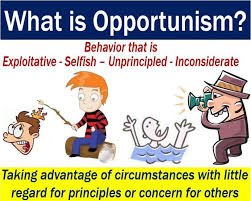
Opportunism is a subtle thing. It does not stand out in the same way as other -isms, yet it seems to be present almost everywhere.
At its core, it is simple: taking advantage of a situation when the opportunity arises.
We see it in many forms — in politics, in business, and in everyday life. And if we are honest, we see it in ourselves as well. We all act on opportunity when it appears. In that sense, it is quite natural.
And yet, something about it makes us uneasy.
We admire initiative. We praise those who recognize and act on possibilities. But there is a line — and we seem to know when it has been crossed.
When taking advantage of a situation comes at the expense of someone else’s vulnerability, we react differently. Then it is no longer seen as skill or awareness, but as something less admirable — something unfair.
That is interesting, because it suggests that beyond our instinct to act on opportunity, there is something else at play. A sense of balance. A sense that not everything that can be done should be done.
Perhaps opportunism is not only about seizing chances, but about how we choose to do so.
And perhaps our reactions to it tell us something about ourselves — about our own sense of fairness, and our quiet expectation that the world should be guided by something more than advantage alone.
Leave a Comment